GTA 6 car theft and the end of being all-powerful: Rob Nelson's IGN interview
The one-button hotwire is gone. A phone app scans a parked car for locks, alarms and trackers, a slim jim opens the old ones, a key cloner starts the new ones, and no crime reaches the police unless somebody sees it or an alarm goes off. What Rockstar's Rob Nelson said, and what it corrects.
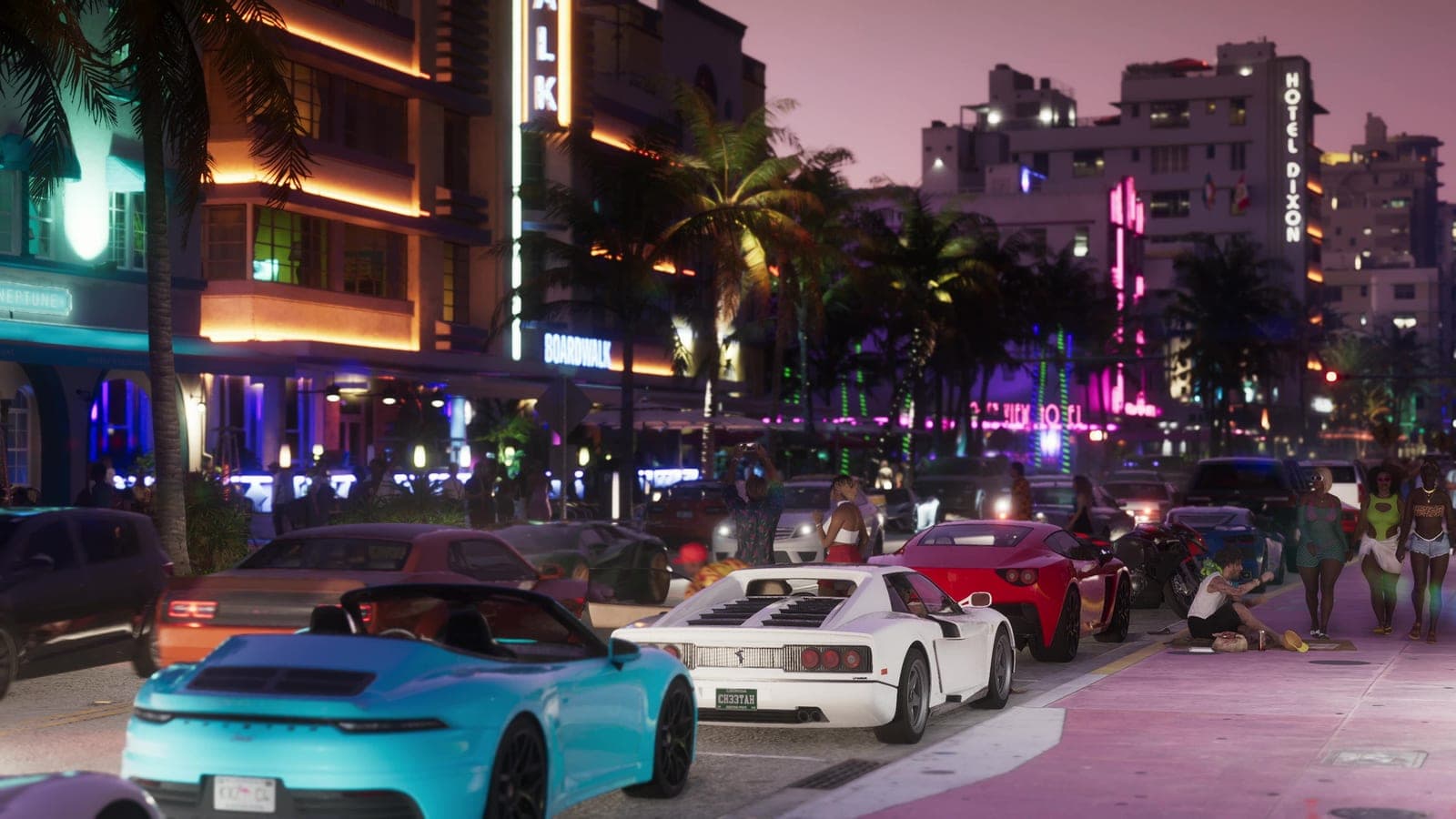
Rob Nelson's argument about Grand Theft Auto VI is that the player has been too strong for too long. Rockstar North's co-studio head put it to IGN in one sentence: in previous Grand Theft Auto games, you were a bit all-powerful. Leonida is not built that way.
That is a thesis rather than a feature, and this site is usually sceptical of those. What makes this one worth a page is that Nelson attached a mechanic to it, and the mechanic is the one every player touches within sixty seconds of starting the game: you can no longer walk up to a parked car and press a button.
Stealing a car in VI is a job with tools in it, a phone app that tells you which tool, and a tracker that may follow you afterwards. Two of those three things were on this site a month ago as unverified leak material. They are not any more, and the correction is below.
The sentence the interview turns on
Nelson's framing of the problem is a criticism of Rockstar's own back catalogue:
The world will act upon you as well as you acting upon the world.
The reasoning he gave around it is the useful part. In the older games, he said, the player was overpowered compared with everyone except the police — which can be fun, but not as fun as a world where other people have impulses of their own and act on them. The line that got quoted everywhere is the plainest version:
You are still powerful and capable, but you are not the only one capable of violence or the only one with weapons or the only crazy person out there.
He traced the approach back to Red Dead Redemption 2 and the gangs in it that come after you, and said the result is a world that is less predictable.
Be clear about what that is and is not. It is a designer describing an intention, before anyone outside Rockstar has played the game. It is not a specification, and nothing in it tells you how often the world will actually push back, or how hard. What it does do is name the principle that several separately announced systems turn out to share — NPCs that escalate instead of fleeing, police who remember what you look like, guns that passers-by can see on you — and it predicts the shape of the one described below.
Stealing a car is now four different jobs
The instant hotwire is gone, and Nelson's reason is that it left a lot of potential gameplay on the table. What replaces it depends on what you are stealing and whether there is somebody sitting in it.
| What you are taking | How you get in | How you start it |
|---|---|---|
| A car with a driver in it | Pull them out — at a junction, at a light, anywhere it is stopped | Nothing. The engine is already running |
| An older parked car | Smash the window, or use a slim jim for a quiet entry | Hotwire it |
| A newer parked car | Smash the window | A key cloner, which performs a relay attack |
| A car you have not unlocked the tools for | You do not | — |
Three things in that table are worth drawing out.
Carjacking is untouched. Nelson was explicit that you can always carjack any driver you see, and the reporting is consistent that running up to an expensive car stopped at a light and dragging the owner out needs no equipment at all. The friction is on parked cars, not on the series' signature move.
The division is old versus new, not cheap versus expensive. A slim jim and a hotwire work on cars with mechanical locks. Anything modern enough to have electronic entry — the game's Tesla analogue is the example in the coverage — needs the key cloner, because you can break the window and sit in the driver's seat and still not be able to start it.
Tools are progression. Nelson's earlier phrasing, already on this site, was that certain parked cars are not accessible until you get further along with the story and acquire certain tools. The car theft system is therefore a gate as well as a minigame: part of the vehicle roster is closed to you at the start of the game and opens as the story runs.
Waink, and what a parked car tells you before you touch it
The connective tissue is a phone app, reported as Waink. Point it at a vehicle and it scans it. Nelson's own example of what comes back:
It tells me this car is locked, it's got an alarm, and has no tracker.
It also prices the car: what it is worth taken to a Pay 'n' Spray or to a specialty car fence, and what it would cost to register the thing to yourself and keep it. So one scan answers three different questions — which tool you need, whether the police will be able to follow it, and whether it is worth more as a sale than as a car.
That last part is the quietly significant one. A stolen vehicle in VI has a resale value and a legitimisation cost attached to it before you have stolen it, which makes theft an economic decision rather than a transport one. Rockstar has not published prices, and nobody should quote you any.
This corrects something we published
Our driving and vehicles breakdown of 4 September listed key cloning and vehicle trackers under what comes from the leaks rather than from Rockstar, and its status table marked both unconfirmed. That was right in September and it is wrong now: Nelson has described both on the record, and that article has been corrected in the same commit as this one.
Two claims from the same leak material have not moved and remain unconfirmed: the highway traffic cameras that apply a wanted level inside a marked zone, and drivers who physically resist being pulled from a vehicle at a stamina cost. A leak being right about one thing is not evidence about the next thing, which is the entire reason the distinction is kept.
What Nelson did add about trackers is that they are the police's route to you, and that getting away cleanly from a tracked car needs an item that disables the tracking device — another tool, in a system that is now made of them.
No crime without a witness or an alarm
The other substantial thing in the interview is a rule the series has never stated out loud before. A crime does not produce a wanted level by happening. Someone has to witness it, or an alarm has to go off, for it to be reported to the police at all.
That turns the opening of every job into a question about sightlines, and it is what Nelson's preferred phrase is built on:
We're really trying to encourage this hit-and-run style of gameplay.
His description of the intended loop is getting into trouble and being gone before the police arrive, without shooting anybody and without escalating. Against that, he set out where it stops working:
- One star is not meant to be difficult to shake. You are clear once you are out of the area the police are responding to.
- Three stars in the city can be hard to escape in a vehicle, in Nelson's words, unless it is a very fast car or a sports bike.
- Beyond that, the heat system is doing the work: what the police know about your face, your clothes, your car and the fact that there are two of you.
One escape route in the interview is new to this site. Alongside changing your outfit and splitting Jason and Lucia up, Nelson lists getting a haircut as a way to stop matching the description. That is the appearance layer and the wanted system meeting in a barber's chair, and it is the clearest sign yet that the heat icons are cleared by going places rather than by waiting.
Confirmed, or not
| Claim | Status |
|---|---|
| The instant one-button hotwire is gone | Confirmed by Rob Nelson |
| Older cars: slim jim entry, then hotwiring | Confirmed by Rob Nelson, relayed |
| Newer cars need a key cloner to start, window smashed or not | Confirmed by Rob Nelson |
| Carjacking an occupied vehicle needs no tools | Confirmed by Rob Nelson |
| Some parked cars are locked until story progress gives you the tools | Confirmed by Rob Nelson |
| A phone app scans a car for locks, alarms and trackers | Confirmed by Rob Nelson |
| The app prices a car for a Pay 'n' Spray, a fence, or registration | Confirmed by Rob Nelson |
| The app is called Waink | Reported by GameSpot and Kotaku, not quoted from Rockstar |
| Vehicle trackers exist and let police follow a stolen car | Confirmed by Rob Nelson |
| An item disables a tracker | Confirmed by Rob Nelson, relayed |
| A crime needs a witness or an alarm to be reported | Confirmed by Rob Nelson |
| One star is comparatively easy to escape; three in the city is not | Confirmed by Rob Nelson |
| A haircut changes the description the police are working from | Confirmed by Rob Nelson, relayed |
| "You are not the only one capable of violence" as design intent | Confirmed by Rob Nelson |
| Prices, payouts, registration costs, how many tools there are | Not published |
| Driving fast enough to outrun a tracker | Reported in preview coverage — no Rockstar statement |
| Highway traffic cameras applying a wanted level in a zone | Leak material only — unconfirmed |
| Drivers resisting being pulled out, at a stamina cost | Leak material only — unconfirmed |
What is still not confirmed
How many tools there are, and how you get them. Two are named. Whether the set is two, five or twenty, whether they are bought, found or unlocked by mission, and whether a tool can be lost have not been described. "You acquire certain tools" is still the whole of the progression anyone has published.
What proportion of traffic is locked. This decides whether the system is a texture or an obstacle. If one car in twenty needs a cloner it is flavour; if one in three does, it changes every getaway on the map. Nobody has given a figure.
Whether the minigames are skill or timing. Coverage describes a short slim jim sequence on the control stick. Whether it can be failed, whether failure makes noise, and whether the key cloner has any interaction at all are unknown, and the button-level descriptions circulating are not from Rockstar.
What a witness actually is. The rule that a crime must be seen or heard is stated; the model underneath it is not. Whether witnesses can be identified and silenced, whether a security camera counts as one, how far an NPC can see, and whether killing the only witness clears the report are all open — and the last of those is a question the criminal profile is likely to have an opinion about.
Whether registration means ownership. Being able to pay to register a stolen car as yours implies a garage, persistence and insurance-shaped systems that Rockstar has not described. Whether a registered car survives being destroyed, where it is stored, and what the police do with one you abandon are unstated.
Any of it in Online. Everything here concerns the single-player game, and a theft economy built on fences and registration raises obvious questions in a shared lobby. Rockstar has published nothing.
Whether the thesis survives contact. A world that acts upon you is a better world than one that does not, right up to the fourth time a key cloner stands between you and a chase you are already losing. Friction that reads as depth in a 26-minute showcase can read as an errand at hour fifty, and that gap cannot be measured before 19 November 2026.
We will update this page as Rockstar confirms things, and again after launch. In the meantime, see driving and vehicles, how the police and wanted system work, what the Extended Look showed, or the vehicle database as it fills in.
Sourcing note: ign.com, gamespot.com, gamesradar.com, kotaku.com and pcgamer.com are all refused by this writer's network, so the original interview could not be read first-hand. Nelson's quotations above are taken from GameSpot's, GamesRadar's and Kotaku's reporting of it, which agree on wording where they overlap; the "all-powerful" line was written up by GameSpot on 7 October 2026, while the same interview's car-theft and overpowered-player material was carried by GamesRadar and Kotaku from late August, around the Extended Look preview round. The lines marked "relayed" above are ones only one of those outlets carries. Where coverage paraphrases rather than quotes, it is paraphrased here too rather than dressed up as a quotation.
Read next
GTA 6 cloud streaming: Xbox was reported to have the exclusive, then denied it
The Verge reported that Xbox Cloud Gaming would be the only service allowed to stream Grand Theft Auto VI at launch. A day later Xbox's own chief strategy officer called it misreporting and said the game will not be streaming 'exclusively or to PC'. Here is what each statement actually claims, and what neither of them settles.
Australia classified GTA 6 first: R18+ on 27 August, with sex scenes written into the advice
The Australian Classification Board put Grand Theft Auto VI on the national register five weeks before the ESRB label appeared — R18+, consumer advice "High impact violence, sex scenes and drug use". It is the only rating the game carries that is law rather than labelling, and it corrects two of our own articles.
GTA 6 has a writing director for the open world, and a team in LA that writes nothing but pedestrians
LOVE issue 27 went on sale on 5 October and named James Horton, Rockstar's open-world writing director. What he says about ambient dialogue, what the satire is pointed at — robocalls, talk radio, the culture wars — and why none of it is a mechanic yet.