How big is the GTA 6 map? What Rockstar has actually said about Leonida's size
Three times Red Dead Redemption 2's playable area, twice GTA V, Vice City twice Los Santos. Rockstar has given four ratios and no area at all — here is what each one means, why the square-mileage figures you have read are worthless, and what the numbers still do not tell you.
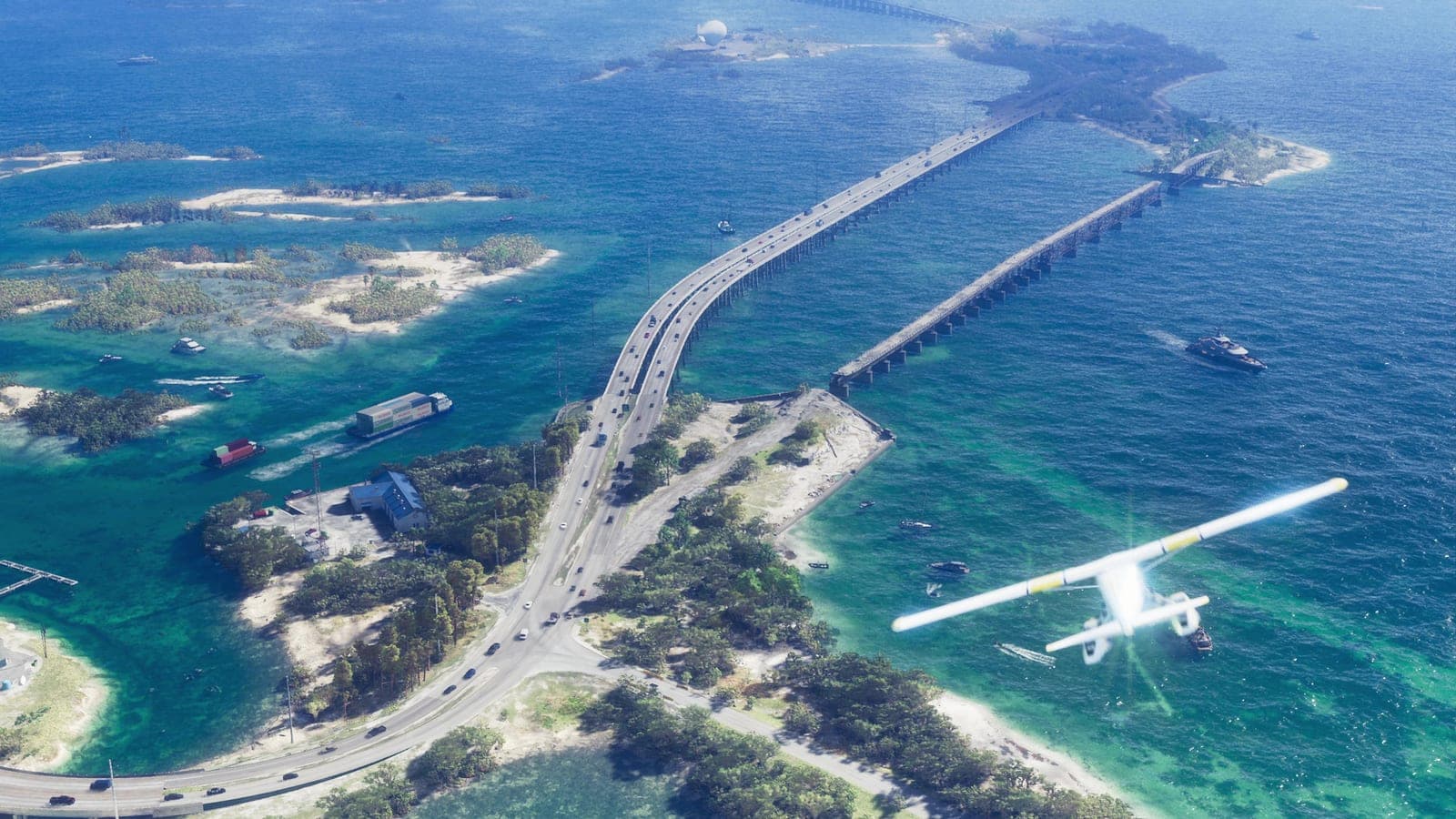
Rockstar has answered the question of how big Leonida is, and the answer is a set of ratios rather than an area. The map is three times the playable area of Red Dead Redemption 2 and twice the size of GTA V's. Vice City alone is twice the size of Los Santos. The built-up ground outside Vice City is eleven times the built-up ground outside Los Santos.
Those four figures come from Rockstar directly. Everything you have read expressed in square miles or square kilometres does not, and this piece is largely about the difference — because the numbers in circulation are not merely unofficial, they contradict each other, and the most-repeated one has a genuinely strange history.
The four figures Rockstar has given
Two independent statements, made within days of each other around the Extended Look, account for everything official.
The first is the New York Times preview, in which Rockstar's developers said the overall map is three times as large as the playable area of Red Dead Redemption 2. It is the same interview that produced the 600,000-animation figure, and the phrasing is worth keeping: playable area, not map, not world.
The second is Rob Nelson, head of development and co-studio head at Rockstar North, speaking to creators invited to Rockstar North for a three-hour preview. His version is more granular, and it is the source of every comparison now being repeated:
The map is twice the size of GTAV and three times that of the playable area of RDR2. The city itself is twice as big as Los Santos, but also, the built-up area outside Vice City is eleven times the built-up area outside of Los Santos in GTAV.
| Comparison | Figure | Source |
|---|---|---|
| Whole map vs RDR2's playable area | 3× | Rockstar, to the New York Times, and Nelson |
| Whole map vs GTA V | 2× | Nelson |
| Vice City vs Los Santos | 2× | Nelson |
| Built-up area outside Vice City vs outside Los Santos | 11× | Nelson |
Four ratios, no area. Rockstar has never published a square-mileage figure for any of its open worlds, and it has not broken that habit here.
The eleven is the one being misquoted
Nelson's fourth figure is the largest and the most widely mangled. It has been reported as "Vice City and its suburbs are eleven times Los Santos and its surroundings", which is not what he said and is a much bigger claim than what he said.
What he described is a comparison of built-up ground outside the city against built-up ground outside the city. Blaine County had a handful of settled places in it — Sandy Shores, Paleto Bay, Grapeseed — and a great deal of empty hillside between them. Leonida's equivalent is Port Gellhorn, Ambrosia, the Keys and the backwoods around Mount Kalaga, all of which are towns rather than hamlets.
So the eleven is not a statement about the size of the map. It is a statement about how much of the map outside the city has buildings on it, which is a claim about density rather than scale — and it sits oddly beside the whole-map figure of 2×. A map twice the size of GTA V's cannot contain eleven times as much of anything without something else shrinking, so the natural reading is that Leonida trades empty terrain for settled terrain. That is the more interesting fact buried inside the number, and it is the part nobody quotes.
Why the square-mileage figures are worthless
Every number you have seen expressed in area — 87 square miles, 125 square kilometres, whatever your feed produced this week — is fan arithmetic performed on top of a Rockstar ratio. There are three separate faults in that arithmetic, and they compound.
The base figures are unofficial. To turn "three times RDR2" into an area you need RDR2's area, and Rockstar has never given one. The figure normally used, roughly 29 square miles, is a community measurement. It may be close. It is not a fact, and multiplying an estimate by a rounded ratio produces an estimate with the rounding baked in and the uncertainty hidden.
The base figures disagree with each other. GTA V is the clearest case. Two numbers are quoted constantly and interchangeably: 49 square miles, and 75.8 square kilometres. The second works out at about 29 square miles. One is two thirds larger than the other, and both are routinely presented as the size of the same map.
The units measure different things. That 75.8 km² figure is a total that breaks down as roughly 48 km² of land and 28 km² of water. Whether you count the ocean changes the answer by more than a third, and nobody quoting a multiplier tells you which convention they are using. For a state built on a coastline, an island chain and a wetland, that choice matters more in VI than it ever did in GTA V.
Where "49 square miles" actually came from
The GTA V figure deserves its own paragraph, because its history is the whole argument in miniature.
Before GTA V shipped, Rockstar said its map would be larger than those of Red Dead Redemption, GTA IV and San Andreas combined. Fans measured those three games and got roughly 28, 6.8 and 13.9 square miles. Added together: just under 49.
That is where the number comes from. "49 square miles" was never a measurement of GTA V. It was the combined size of three other games, quoted as a lower bound by a marketing claim, and it has been repeated for thirteen years as though someone had surveyed Los Santos. The same process is now running on Leonida in real time, one ratio further from anything measured.
The ratios do not reconcile, and that is informative
Take Nelson's first two figures together. If Leonida is 2× GTA V and 3× RDR2's playable area, then GTA V is 1.5× RDR2's playable area.
Now check that against the community measurements everyone is multiplying: RDR2 is usually put at around 29 square miles of land, GTA V at around 48 square kilometres of land — roughly 19 square miles. Those figures make RDR2 comfortably larger than GTA V. Nelson's ratios require the reverse, by half again.
Both cannot be right, and the useful conclusion is not that anyone is lying. It is that Rockstar is measuring something the fan surveys are not — most likely total map extent including water against RDR2's walkable land, or a definition of "playable area" that excludes ground the community counted. The two systems of numbers are incompatible, so mixing them, which is what every square-mileage estimate of Leonida does, produces a figure that means nothing at all.
Comparative claims from Rockstar are trustworthy because Rockstar can measure its own maps consistently. The moment you convert one into an area you have left Rockstar's measurement system for somebody else's.
The leaked map does not settle it
A full map image sourced from a development build circulated in August 2026, ahead of the Extended Look, and Rockstar responded with takedown notices — which is, in the narrow sense, an acknowledgement that it came from somewhere real.
It still does not answer this question. An image of a map with no scale on it is not a measurement, a development build is not the shipping game, and a coastline traced from a leak measured against a coastline traced from a different leak is two unknowns being divided by each other. We do not link to leaked material and we do not describe where to find it. The relevant point is narrower: nobody outside Rockstar has measured Leonida, including the people who have seen it.
The organised mapping communities doing this work — the long-running GTAForums project, among others — are careful and open about their error bars, and their output is a good deal more honest than the headlines built from it. Treat their figures as what they are: reasoned estimates from people who say they are estimates.
Confirmed, or not
| Claim | Status |
|---|---|
| Whole map is 3× RDR2's playable area | Confirmed by Rockstar to the New York Times, and by Rob Nelson |
| Whole map is 2× GTA V | Confirmed by Rob Nelson |
| Vice City is 2× Los Santos | Confirmed by Rob Nelson |
| Built-up area outside Vice City is 11× that outside Los Santos | Confirmed by Rob Nelson |
| Vice City is the largest city Rockstar has built | Confirmed by Rockstar |
| Any figure in square miles or square kilometres | Never published by Rockstar for any of its games |
| Whether the ratios count water | Not stated |
| Whether "playable area" includes interiors | Not stated |
| A full official map image | Not released |
| Traversal times across the state | Not published |
| Any leaked map or fan measurement | Unofficial — not a measurement of the shipping game |
What is still not confirmed
What is being measured. This is the load-bearing gap. Rockstar has given four ratios without once defining the quantity on either side of them — land, total extent, navigable water, walkable interiors. Every attempt to convert them into an area silently picks a definition on Rockstar's behalf.
How the map is distributed. Two times GTA V is a total. It says nothing about the split between Vice City, the wetlands, the Keys and the northern parks, and the eleven-times figure hints that the distribution is unusual without describing it. A state that is mostly Grassrivers and a state that is mostly city are the same number and different games.
How long it takes to cross. No official traversal time exists for any route, in any vehicle. Given that VI adds fuel and vehicle-access friction to driving, the relationship between distance and time is not the one GTA V trained everyone on, and a bigger map with slower movement is a substantially different proposition from a bigger map alone.
Whether the number is the point. Nelson's most revealing remark about scale was not a ratio at all:
The game is so big, I don't know that there's anybody on the team that knows all of it.
Read as marketing that is a boast. Read as a production fact it is a genuine risk, and it is the honest version of what large means here. RDR2 was the most detailed world ever built when it shipped and the most common complaint about it was still emptiness between the good parts. Area is the easiest thing about a map to announce and the least reliable predictor of whether it is worth crossing — what fills it is covered in world density and NPCs, and what is in each region in the Leonida breakdown.
None of this resolves before launch on 19 November 2026. When it does, the first credible area figure will come from someone walking the coastline with a mod, not from Rockstar — and it will still be a measurement of somebody's definition. We will update this page then. In the meantime the interactive map answers the more useful question hiding behind this one — not how big Leonida is, but what is actually in it, region by region.
Read next
The Rockstar tribunal: what a Glasgow courtroom has revealed about GTA 6
Rockstar dismissed 34 staff across its UK and Canadian studios on 30 October 2025. Thirty-one of them are now in front of an employment tribunal in Glasgow that runs until mid-October, and Rockstar's own filings have become the first place the studio has ever referred to a GTA VI online format.
Miami is being turned into Vice City: the rooftop sign, the beach deal, and who signed them
A helicopter lifted WELCOME TO VICE CITY onto the roof of the Miami Heat's arena on 22 September. Miami-Dade County is collecting $975,000 for it, Miami Beach has voted 4-3 to take at least $3 million more, and Rockstar has said nothing publicly about either. Here is what the public records actually show.
GTA 6 police and wanted levels: six stars, heat icons, and what the cops know about you
Six wanted stars are back, and underneath them sits a row of icons showing exactly what the police have on you — your face, your clothes, your car, your partner, the CCTV. Here is how the heat system works in Grand Theft Auto VI, and what Rockstar still has not said.