Miami is being turned into Vice City: the rooftop sign, the beach deal, and who signed them
A helicopter lifted WELCOME TO VICE CITY onto the roof of the Miami Heat's arena on 22 September. Miami-Dade County is collecting $975,000 for it, Miami Beach has voted 4-3 to take at least $3 million more, and Rockstar has said nothing publicly about either. Here is what the public records actually show.
On Tuesday 22 September a helicopter lowered letters one at a time onto the roof of the Kaseya Center, and the building that hosts the Miami Heat now reads WELCOME TO VICE CITY. The county that owns the arena is being paid $975,000 for it. Eight miles east, Miami Beach has separately voted to take at least $3 million to let Rockstar brand its chairs and umbrellas from the middle of October.
This is the first Grand Theft Auto marketing campaign that has needed municipal votes, and the interesting part is not the sign. It is that both deals are public records, so for once the numbers, the dates and the objections are all on paper — while Rockstar itself has said nothing publicly about any of it.
This piece sets out what each agreement contains, who approved it and how, what was said against it, and which parts of the reporting are firm enough to rely on.
What went up, and where
The letters are pink and white, they were airlifted into place individually, and they sit on the roof rather than on the facade — which means the audience is partly aerial. The arena is on the downtown waterfront under the approach into Miami International, so aircraft on descent get a clear look at it.
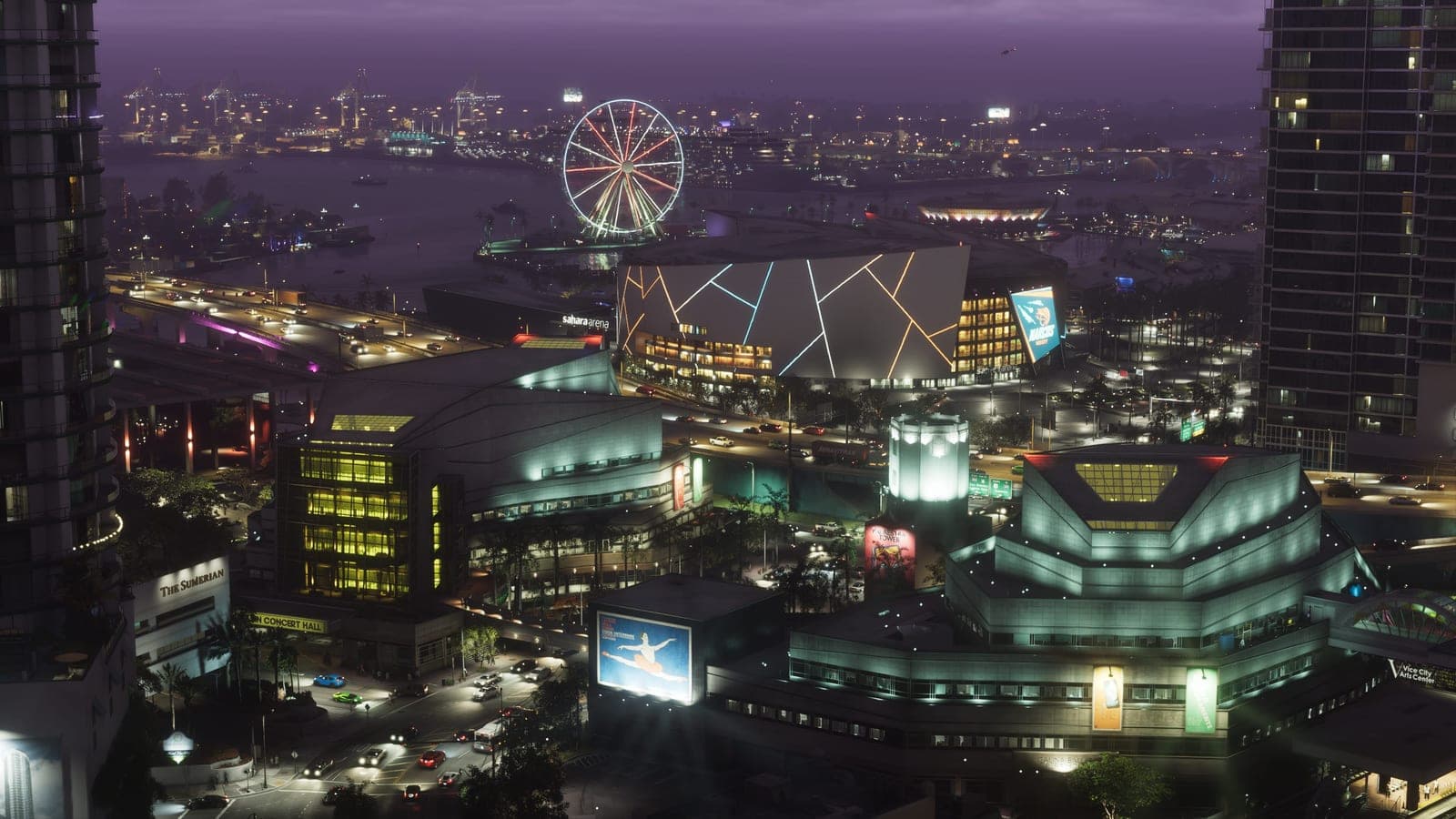
That location is not incidental. The Kaseya Center sits in the stretch of downtown Miami that Vice City's own waterfront is built from, and Rockstar's official still of the district — the one at the top of this page — shows a lit arena on exactly that piece of shoreline, signed Sahara Arena, with a ferris wheel behind it. Rockstar has never said the Sahara Arena stands for the Kaseya Center. The resemblance is a reader's inference from a published image, and the fact that the real building is now wearing the fictional city's name does not turn it into a confirmation.
The county deal: $975,000, and no board vote
Miami-Dade County owns the Kaseya Center. The agreement with Rockstar Games is worth $975,000 to the county, and the figure matters for a procedural reason: Mayor Daniella Levine Cava holds delegated authority to sign contracts under $1 million without taking them to the Board of County Commissioners. At $975,000, this one did not go to a vote.
The money is earmarked for developing a parcel of county land behind the arena that has been promised for community use — a park — for years.
Commissioners learned about it late. The mayor's chief of staff, Christopher Hudtwalcker, announced the deal during the county's budget meeting at around 1:30am, describing Grand Theft Auto VI as "the biggest cultural phenomenon of the year". Several commissioners said afterwards that this was the first they had heard of it.
| Term | What the county agreement provides |
|---|---|
| Payment to Miami-Dade | $975,000 |
| Signed by | Mayor Daniella Levine Cava, under delegated authority |
| Board vote | None — the sum falls below the $1 million threshold |
| Installed | 22 September 2026, by helicopter |
| Proceeds earmarked for | County land behind the arena, long promised as community space |
The objection was about the threshold, not the game
The sharpest criticism at the budget meeting was not about Grand Theft Auto. Commissioner Oliver Gilbert III went at the structure of the deal:
I do not agree that you can do $900,000 for this, and $700,000 for this, and $400,000 for this, and because you did different agreements, then you don't have to come before the board.
That is a complaint about a series of sub-threshold contracts adding up to something that would have required a vote if it had been written as one. Commissioner Natalie Milian Orbis put the milder version — "I would've appreciated more information" — and Commissioner Juan Carlos Bermudez raised the county's reputation, arguing that a game built around crime is a poor thing for Miami-Dade to be selling its roofline to.
Miami Beach: a separate deal, approved 4-3
Miami Beach is a different city with its own commission, and it took its own vote on 10 September. It passed 4-3.
| For | Commissioners Tanya Bhatt, Laura Dominguez, Joseph Magazine, Monica Matteo-Salinas |
| Against | Mayor Steven Meiner, Commissioners Alex Fernandez, David Suarez |
| Value | At least $3 million, reported as potentially closer to $4 million |
| Runs | 15 October to 31 December 2026 |
| What appears | Branding on beach chairs, umbrellas and banners |
The campaign was described in the meeting as "very discreet, understated, mostly the Roman numeral six" — the VI mark rather than the words Grand Theft Auto, which is why what is going onto the beach furniture will read as a logo to anyone who does not already know the game. The city has indicated the money could cover a renovation of the Flamingo Park Memorial Football Field, a project scheduled for next year without funding attached.
Opponents made the argument you would expect. David Suarez set out what players do in the game — steal cars, deal drugs, rob, kill civilians, shoot at police — and said that while Rockstar is entitled to make and advertise it, Miami Beach is not obliged to help. The line that travelled furthest came from the other side of the vote, from Monica Matteo-Salinas:
We're not giving away pistols and cocaine to people.
Her point was about the branding, not the game: chairs and umbrellas are chairs and umbrellas, and the people who play Grand Theft Auto are not going to commit crimes because a parasol has a Roman numeral on it.
Where the campaign started, and who tried to stop it
This did not begin with Rockstar approaching Miami. A public records request reported in early September showed that Mayor Levine Cava's office pitched a "GTA VI × MDC" collaboration to Rockstar in June 2026 — county-land installations including a proposed "Vice City Motor Fest" of classic cars, lowriders and local entertainment, framed as supervised and family-friendly. A spokesperson for the mayor said at the time that nothing had been "formally agreed to or approved".
The pitch drew the campaign's most senior opponent. Miami-Dade Sheriff Rosie Cordero-Stutz came out against it in a joint statement with Commissioner Bermudez, on the grounds that the fictional world being advertised "includes murder, robbery, drug trafficking, carjacking, violence against law enforcement" and other conduct her office works "every single day to prevent".
The sheriff's objection did not stop the arena sign, which was signed under an authority that does not require her agreement or the board's. Whether it constrains anything later is open — the Motor Fest event has not been announced, and the county's appetite for a second agreement is now a live political question rather than an administrative one.
Why this is happening now
The timing lines up with the launch calendar rather than with anything in the game. Miami Beach's branding window opens 15 October and closes 31 December; the game arrives on 19 November, squarely inside it. The arena sign went up eight weeks out.
It is worth being clear about what this campaign is and is not. It is place marketing: Rockstar is buying the physical city that Vice City is modelled on and letting the two names sit on top of each other for a season. It tells you nothing about the game's content, its map, its release plan or its features. Nobody has learned anything about Leonida from a rooftop sign.
Confirmed, or not
| Claim | Status |
|---|---|
| A WELCOME TO VICE CITY sign was installed on the Kaseya Center on 22 September | Reported by local media at the scene |
| Miami-Dade is being paid $975,000 | County agreement |
| It was signed under delegated authority, with no board vote | County procedure, stated at the budget meeting |
| Proceeds are earmarked for county land behind the arena | Stated by the mayor's office |
| Miami Beach approved its own deal 4-3 on 10 September | City commission record |
| Miami Beach's deal is worth at least $3 million, running 15 Oct - 31 Dec | City commission record; the "closer to $4 million" figure is an estimate |
| The mayor's office pitched the collaboration to Rockstar in June 2026 | Public records request |
| Sheriff Cordero-Stutz opposed the campaign | Joint statement with Commissioner Bermudez |
| How long the arena sign stays up | Reported as up to a year, tied to the Heat's season — not confirmed by the county |
| Any statement from Rockstar about either deal | None published |
| The Sahara Arena in VI representing the Kaseya Center | Never said by Rockstar |
| A "Vice City Motor Fest" event happening | Pitched only; not agreed or scheduled |
What is still not confirmed
How long the sign stays. It has been reported as standing for about a year, or until the Heat's last home game of the season. The county has not published the term, and until it does, the end date is reporting rather than record.
Whether there is more coming. Gilbert's objection implies the mayor's office was contemplating a sequence of agreements under the $1 million line. None has been announced. If one is, it will arrive the same way this one did — signed, not voted on — unless the board changes the threshold first.
What Rockstar thinks of any of it. Every figure, date and quote above comes from Miami-Dade County, the City of Miami Beach, or journalists in the room. Rockstar has published nothing: no Newswire post, no statement, no confirmation that the campaign exists. That is consistent with how the studio has run this entire launch, and it means the only party to the deals that has not described them is the one paying.
Whether the sign appears in the game. It does not, and there is no reason to expect it to. VI was finished long before a county signed anything, and a real building wearing a fictional city's name is a billboard, not a crossover.
Whether any of this reaches players outside Florida. A rooftop sign visible from a landing aircraft and a set of branded umbrellas in South Beach are a local campaign with a national press tail. What the rest of the marketing looks like between now and 19 November has not been announced, and the two Miami agreements are not evidence about it.
We will update this page if the county publishes the agreement term or a second deal appears. In the meantime, the game itself is still the better subject: what the map is built from, which districts Rockstar has actually named, or everything with a confirmed position on the interactive map.
Read next
The Rockstar tribunal: what a Glasgow courtroom has revealed about GTA 6
Rockstar dismissed 34 staff across its UK and Canadian studios on 30 October 2025. Thirty-one of them are now in front of an employment tribunal in Glasgow that runs until mid-October, and Rockstar's own filings have become the first place the studio has ever referred to a GTA VI online format.
GTA 6 police and wanted levels: six stars, heat icons, and what the cops know about you
Six wanted stars are back, and underneath them sits a row of icons showing exactly what the police have on you — your face, your clothes, your car, your partner, the CCTV. Here is how the heat system works in Grand Theft Auto VI, and what Rockstar still has not said.
Rockstar's mod guidelines: what the new rules ban, and what they change for GTA 6
Rockstar has published a company-wide modding policy that forbids fan-made story expansions, cross-game map merges and unofficial ports, and limits multiplayer modding to one licensed platform. It covers Grand Theft Auto VI — a game with no PC version announced.