Two guns are missing from GTA 6's banner outside Paris — and the law being cited is about something else
A banner reproducing the Grand Theft Auto VI cover art has gone up on the Mercuriales towers at Porte de Bagnolet with Lucia's pistol and an assault rifle removed. Rockstar has said nothing. France's 1985 firearms advertising law governs adverts for guns, not guns in adverts, and the claim that every GTA 6 poster worldwide has been edited rests on nothing solid.
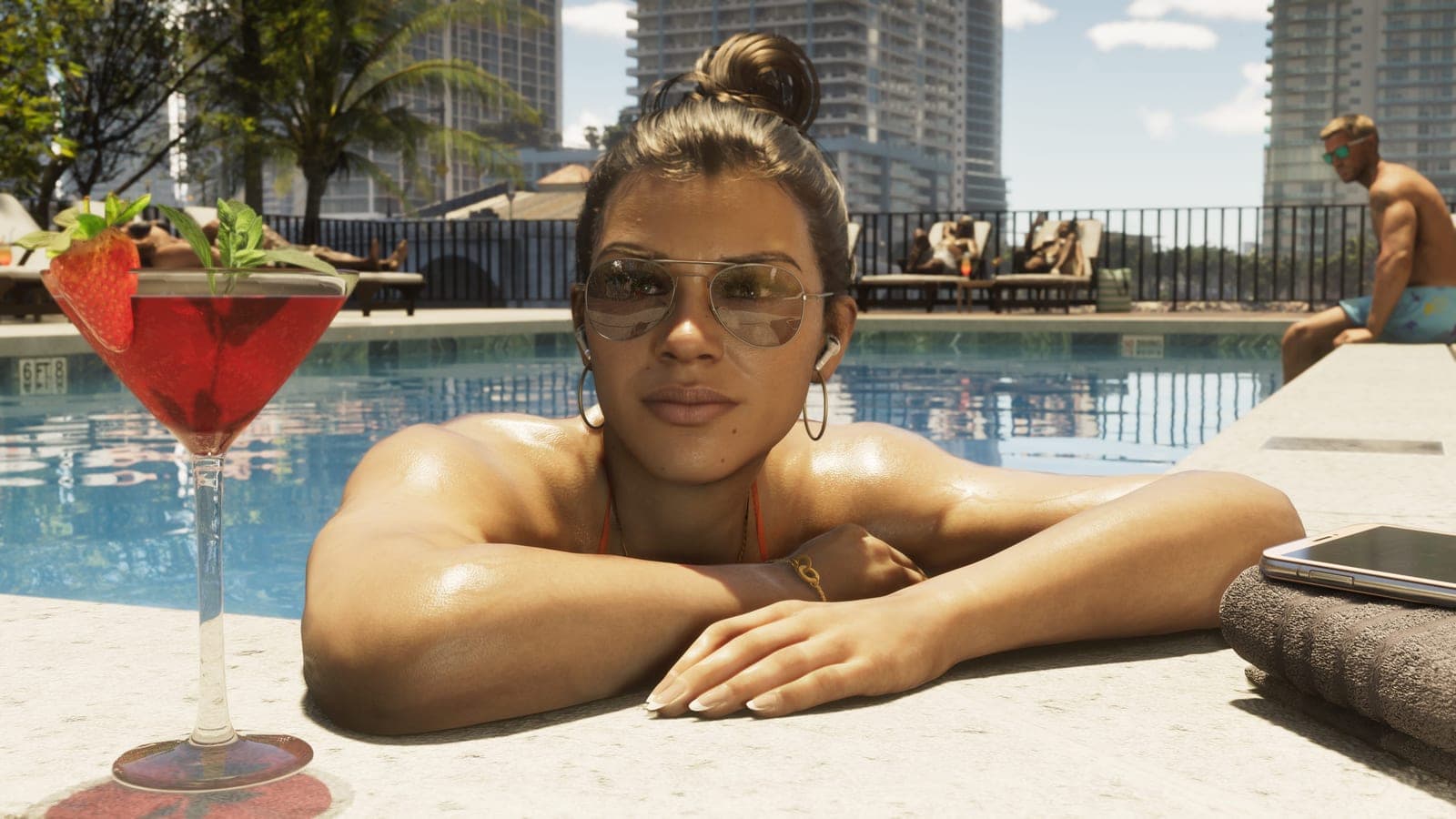
A banner the height of an office tower has gone up on the eastern edge of Paris carrying the Grand Theft Auto VI cover art, and two of the guns in that cover art are not on it. The pistol Lucia Caminos holds is gone. So is an assault rifle from a lower panel. Everything else — the layout, the faces, the vehicles, the logo — is the published artwork.
Kotaku reported it on 16 October, crediting the people who spotted it. Rockstar has said nothing about the banner, the edit, or who made it.
What has filled that silence is two confident explanations, and neither survives contact with the evidence. The first is that French law forbids showing a gun on a billboard. The second is that Rockstar is quietly scrubbing weapons from its artwork everywhere. The first misreads a statute that is about something else; the second rests entirely on sources this site does not use.
What is actually established
| Status | |
|---|---|
| A banner reproducing the VI cover art is installed on one of the Mercuriales towers | Photographed, widely |
| Lucia's pistol is absent from it | Visible in the photographs |
| An assault rifle in a lower panel is absent from it | Visible in the photographs |
| The rest of the artwork is unaltered | As reported; no side-by-side has been published by anyone |
| Who ordered the edit | Unknown. Rockstar, the advertiser's agency, the building's owner and the local authority have all been proposed. None has said anything |
| Why | Unknown. No explanation has been given by anyone |
| That the same edited version is running in other cities | Unverified — see below |
| A Rockstar statement of any kind | None |
| Any change to the game, its rating or its release | None |
The building, which is not in Paris
The coverage says Paris. The towers are in Bagnolet, a commune in Seine-Saint-Denis immediately east of the city boundary, and the distinction is the whole reason the site is worth buying.
Les Mercuriales are a pair of towers — Levant and Ponant — built in 1975 beside the Boulevard Périphérique at the Porte de Bagnolet interchange with the A3 motorway. They were modelled on New York's World Trade Center, the project stalled in the first oil crisis, and they have stood more or less alone ever since: the Ponant tower reaches about 175 metres with its antennas, the tallest in the department. They are the first thing a driver sees coming into Paris from Charles de Gaulle on the A3, and they are visible from the ring road that every vehicle crossing the east of the city uses.
In other words, this is the French equivalent of the sites Rockstar has been buying all autumn — a landmark with forced traffic — and it belongs in the same list as the Kaseya Center roof and the Williamsburg wall rather than in a story about censorship.
What France's firearms advertising law actually covers
The law being cited is Law no. 85-706 of 12 July 1985, with its implementing decree of 9 December 1985. As it is described in the French parliamentary record and in the reporting of it, its subject is advertising for firearms and ammunition — promotion of the things themselves, restricted to specialist hunting, fishing and sport-shooting media and to readers who have asked for it. Firearms also sit on the list of products that may not be advertised on French television at all.
That is a rule about what is being sold. A poster advertising a video game, which happens to depict a character holding a pistol, is not an advertisement for a pistol. This exact distinction was argued in public in 2016, when a municipal poster campaign in Béziers showing a handgun drew complaints: the defence offered was that the campaign sold no weapons and therefore fell outside the 1985 law, and no prosecution followed.
So the confident version — "guns are banned from advertising in France" — is not what the statute says. This site has not read the statute, and nothing here is a legal opinion. What can be said is that the law people are reaching for addresses a different kind of advertisement, and that nobody citing it has pointed to a provision that would require this edit.
There are at least three other mechanisms that would, and all of them are more boring:
- The industry's own advertising codes. The ESRB's Advertising Review Council publishes marketing guidelines that apply to a game's advertising regardless of the game's rating, explicitly cover billboards, and name weapons directly — weapons pointed at the audience, and prolonged or excessive display of weapons, among the things to avoid. The IARC guidelines that govern marketing across rating regions carry comparable language. An M-rated game may contain what its marketing may not show. Nobody has said the ARC or the IARC is involved here, and the unedited cover art is on sale on shelves, so this cannot be a blanket rule applied to the image itself.
- The landlord and the media owner. A banner that size is hung with the building owner's agreement, through an out-of-home operator with its own acceptance policy. Either can decline an image without any law being involved, and that is the single most common reason outdoor artwork gets changed.
- Rockstar's own territorial judgement. Publishers routinely prepare regional versions of key art. Choosing a quieter image for a motorway-facing banner in a country with no gun culture to speak of is a marketing decision, not a concession.
None of the four is confirmed. The honest position is that the edit is real and the reason for it is unpublished, and anyone telling you which it is has guessed.
The "worldwide censorship" claim
The second story to come out of this is that the same de-gunned artwork is now running everywhere: Times Square, a bus livery in Chicago, the Hard Rock Stadium in Miami.
That claim does not currently stand up. It appears on aggregators and in social-media posts; the outlets this site treats as reliable have covered the Bagnolet banner and nothing more. At least one account points the other way, reporting that murals in the United States have kept their weapons — which, if true, is also the simpler reading, because the Brooklyn mural was photographed in pencil with no one remarking on a missing gun and the artwork on the boxes in shops is the unedited one.
Two separate things are being run together here. A single banner was edited. Whether a campaign-wide edited version exists is a different question, and it would need someone to publish photographs of the same panel in two cities. Nobody has.
| Claim | Where it comes from |
|---|---|
| The Bagnolet banner is missing two guns | Photographs; Kotaku, 16 October 2026; Eurogamer's German edition the same day |
| Edited artwork at Times Square, on a Chicago bus, at the Hard Rock Stadium | Aggregators and social posts only — unverified |
| US murals have kept their weapons | Reported, also thinly — unverified |
| Rockstar is rolling out a sanitised global campaign | Nothing supports this |
The series has had this fight before, and it was not about the artwork
This is worth knowing because it is the only part of the story with a documented ending.
In April 2008 the Chicago Transit Authority pulled a Grand Theft Auto IV bus campaign, reported at around $300,000, within days of the ads appearing on 22 April. Take-Two sued in federal court in Manhattan on free-speech and contract grounds. The case settled in September 2008, and the ads went back on the buses that November. The CTA board then voted to bar advertising for any game rated M or above; the Entertainment Software Association sued over that policy in July 2009, and a US district court enjoined it, with the ruling reported in January 2010 on the ground that the advertisements carried constitutional value.
The pattern in that history is the useful part. Every one of those fights was about where the advertisement could run, and none of them was about what the game contained or how it was rated. The rating stayed where it was throughout. If the Bagnolet banner turns out to have been changed at someone's insistence, it will belong to the same category: a dispute over a wall, settled privately, with no consequence for the product.
What this does not mean
- It is not a ratings decision. Grand Theft Auto VI's ratings were published on 1 and 2 October — ESRB Mature 17+, PEGI 18 — and nothing has moved since. A board rates the game; it does not approve a banner.
- The cover art has not changed. The artwork published in June ahead of pre-orders is still the artwork, on the store listings and on the boxes.
- Nothing has been cut from the game. An advertising edit tells you about an advertising contract. It says nothing whatever about what is in the software, and anyone presenting it as evidence of content being removed has made the leap without a bridge.
- The date has not moved. The game ships on 19 November on PS5 and Xbox Series X|S.
Where it sits in the campaign
Three weeks ago the whole of Grand Theft Auto VI's outdoor advertising was in one American metropolitan area, documented through Miami-Dade's and Miami Beach's own paperwork. Then it reached Brooklyn. It is now on a motorway interchange in Seine-Saint-Denis.
That is the actual news in this story: the campaign has gone international, five weeks out, on exactly the schedule a game with this release date would be expected to follow. The missing pistol is the detail that made it travel, and the detail is genuinely unexplained — but the pattern underneath it is an ordinary launch doing ordinary things.
The two people on the banner are the two the game has been about since December 2023, and what is actually established about them sits on their own pages, Lucia Caminos and Jason Duval, rather than in a crop of a billboard.
What is not confirmed
- Who edited the artwork, and at whose request. No agency, no media owner, no building owner and no official has been named by anyone.
- Why. No explanation has been published. The four mechanisms above are candidates, not findings.
- Whether the banner is officially a Rockstar placement. It is overwhelmingly likely from its scale and subject, and Rockstar has not said so, exactly as with the Brooklyn wall.
- Whether edited artwork exists outside Bagnolet. Claimed, unverified, and contradicted by at least one account.
- Whether anything in France's advertising law bears on this. The 1985 statute as described concerns advertising for firearms. No one has identified a provision that reaches a depiction in a game advertisement, and this site has not read the text.
- How long the banner stays up. No dates have been published for it, unlike the Miami agreements, which are public records.
Sourcing note: kotaku.com, eurogamer.net, rockstargames.com, esrb.org, videogameschronicle.com, gamespot.com, pcgamer.com and gamesradar.com all fail to resolve from this writer's network and the egress proxy refuses CONNECT, so nothing below was read first-hand and no photograph was examined directly. The banner, its location on the Mercuriales towers, and the two removed weapons are carried as Kotaku reported them on 16 October 2026 and as Eurogamer's German edition reported them the same day, concordantly. The towers' construction date, their names, their height and their position on the Périphérique at Porte de Bagnolet come from general reference sources rather than games coverage. Law no. 85-706 of 12 July 1985 and its December 1985 decree are described from the French Senate's published answers to written questions and from reporting of the 2016 Béziers case; the text itself was not read, which is why the section about it is framed as what the law addresses rather than as advice. The ESRB Advertising Review Council and IARC marketing guidelines are described from secondary accounts of those documents for the same reason. The 2008 Chicago Transit Authority dispute, the September 2008 settlement, the November 2008 return of the ads and the January 2010 injunction against the CTA's M-rated advertising ban are established in contemporaneous GameSpot and general news reporting. The Times Square, Chicago bus and Hard Rock Stadium sightings appear only on aggregators and in social posts and are labelled unverified above rather than repeated as fact.
Read next
GTA 6's launch trailer, measured: the same 1440p, no QSSR, and a judder that has been there since 2008
Digital Foundry put the Grand Theft Auto VI launch trailer through a frame-by-frame analysis on 16 October. It found no resolution drop, no sign of the PlayStation 5's new QSSR upscaler, and a RAGE engine animation fault going back to GTA IV that now appears to be gone. Here is what a compressed 90-second video can establish, and what it cannot.
Germany, Japan and Korea have now rated GTA 6 — and the last three labels are the ones with teeth
The USK classified Grand Theft Auto VI on 13 September and nobody noticed for a month. CERO's Z appeared on the Japanese store pages on 17 October, and Korea's new private board cleared it on the 16th. That completes the set — but "adults only everywhere" is not what has happened.
A Vice City blimp over South Florida and GTA 6 cars on Miami's streets — neither one needed a county vote
A Goodyear airship in Grand Theft Auto VI livery crossed South Florida on 15 October and is booked for NASCAR's championship weekend. A convoy of road cars dressed as in-game vehicles has been filmed around Miami. One of the two has a tail number and a published schedule; the other has no named owner at all.