GTA 6's launch trailer, measured: the same 1440p, no QSSR, and a judder that has been there since 2008
Digital Foundry put the Grand Theft Auto VI launch trailer through a frame-by-frame analysis on 16 October. It found no resolution drop, no sign of the PlayStation 5's new QSSR upscaler, and a RAGE engine animation fault going back to GTA IV that now appears to be gone. Here is what a compressed 90-second video can establish, and what it cannot.
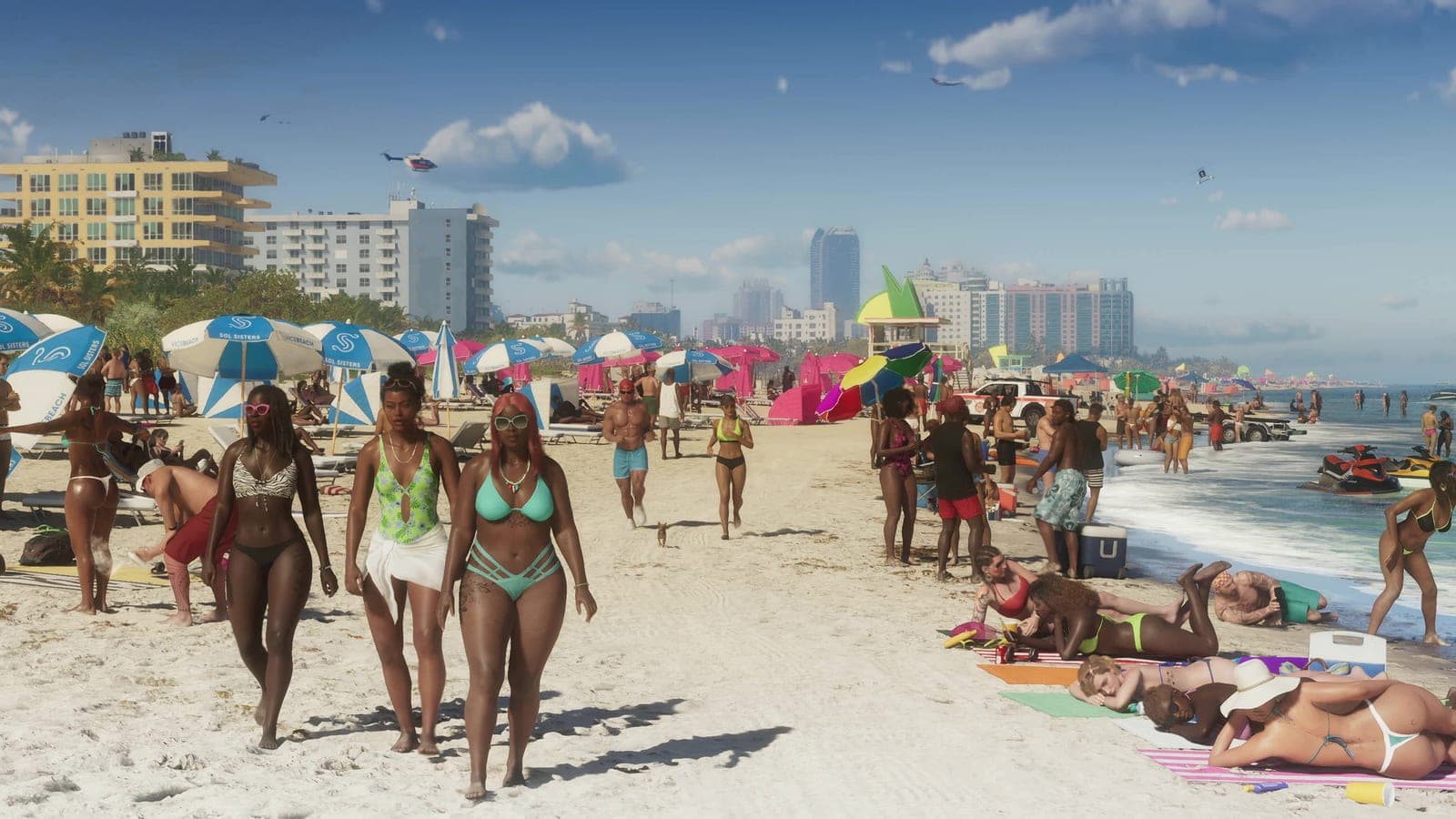
Digital Foundry published a frame-by-frame analysis of the Grand Theft Auto VI launch trailer on Friday 16 October, the day after Rockstar posted it. It is the second technical reading of official GTA VI footage, after the same team's work on the Extended Look in August, and it arrives into an argument that had got going without any measurement at all.
Three findings came out of it. The resolution has not moved. There is no sign of QSSR, the upscaler Sony brought to the standard PlayStation 5 a fortnight ago. And an animation fault that has been in Rockstar's engine since 2008 appears to have been fixed.
The third is the one worth keeping. The first mostly ends a story that should not have started.
What the analysis found
| Finding | What it is worth |
|---|---|
| Roughly 1440p internal, upscaled to a 4K output, on a base PlayStation 5 | An inference from compressed video — and the second such reading to land on the same number |
| No change in resolution against earlier official footage | Ends the "downgrade" claim, which had no evidence behind it either way |
| No evidence of QSSR | Absence in one capture, of a feature that needs game-side work. Not a statement about the shipping build |
| The long-standing RAGE animation judder appears absent | The genuinely new observation — and Digital Foundry flags its own small sample |
| Ray-traced reflections and lighting, still heavy | Consistent with the August reading. Nothing has been cut back on screen |
| HDR presentation called a weak point | Relayed from the analysis; the sharper version of that claim is somebody else's, see below |
| 30fps | A property of the video file at least as much as of the game |
| Anything specific to the PS5 Pro | Nothing. No evidence of Pro-specific work in the footage, and nothing published by anyone |
The resolution did not move
The loudest reaction to the launch trailer was that it looked soft — hazier than the May 2025 trailer, with heavier bloom and less foliage detail — and the reading attached to that was a downgrade: Rockstar had dropped the image quality to make the frame rate.
Digital Foundry's measurement says no. The trailer reads as about 1440p rendered internally and upscaled to a 4K output on a base PlayStation 5, which is the same arrangement the team read off the Extended Look in August, and no resolution change against the earlier material. Its explanation for the softness is narrower and duller than a downgrade: the look may be specific to this particular capture.
That is worth stating plainly, because the soft-trailer argument was an argument about a compressed video posted to social networks. A YouTube-grade encode of 90 seconds of a dense, bright, high-motion open world is the single worst instrument anyone could pick for judging a renderer. What the analysis adds is not certainty — it is still a reading of a compressed file, as the frame rate piece sets out — but it is a second independent data point landing on the same number, which is more than the haze theory ever had.
The judder is the finding worth keeping
This is the part that is actually new, and most of the coverage buried it under the resolution.
RAGE has carried a specific animation fault since Grand Theft Auto IV in 2008: during slow camera movement, animation updates fail to keep step with the displayed frames, so a pan that is running at a perfectly steady frame rate still looks subtly stuttery. It survived into Grand Theft Auto V and Red Dead Redemption 2, and it was visible in the Extended Look in August — the same signature for eighteen years.
Digital Foundry reports that it is not there in the launch trailer, including in the slow pans where it would normally be obvious.
Two things to hold alongside that, the second of them the analysis's own.
- This is an engine behaviour, not a setting. If it is genuinely gone, somebody changed how RAGE times animation against the frame it is drawing, which is a deeper piece of work than it sounds and a more interesting one than any resolution figure.
- Ninety seconds is not proof. Rockstar chooses every shot in a trailer, and a cut that never holds a slow pan long enough will not show the fault whether or not it has been fixed. Digital Foundry says so itself. The retail build on 19 November is what settles it.
No QSSR, and what that does not mean
QSSR — Quick Spectral Super Resolution — is Sony's AI upscaler for the standard PlayStation 5, a cut-down relative of the PS5 Pro's PSSR built with AMD. It arrived quietly in the system software update of 1 October 2026, which mentioned it nowhere in its patch notes, and it is live so far in Marvel's Wolverine and Ghost of Yōtei. Sony's framing is that PSSR remains the Pro's solution and QSSR is a lighter tier for the base machine.
Digital Foundry found no sign of it in the trailer. Three reasons that settles very little:
- It is not automatic. QSSR has to be integrated per title. Sony's engineers describe it as close to a drop-in for games that already use PSSR — and Rockstar has never said GTA VI uses PSSR.
- The footage predates the build. A trailer published five weeks before release was captured at some unstated earlier point, from a build of unknown vintage. An upscaler that went public on 1 October is not something a trailer can rule out.
- Nobody has claimed it. Rockstar has not mentioned QSSR. Sony has not listed GTA VI among the games using it. There was never a claim here to confirm or deny.
The same silence covers the more expensive machine. The PlayStation Store listing has carried a PS5 Pro Enhanced tag since pre-orders opened in June, and in four months neither Sony nor Rockstar has published a sentence about what it does. The analysis found no evidence of Pro-specific work in the trailer either, which is unsurprising: Rockstar's capture note names a PlayStation 5.
What a 90-second video cannot tell you
Four limits, and they apply to every trailer analysis anyone will publish between now and launch.
The file is 30fps, so 30fps is the ceiling of what can be measured. Nothing above it could appear in the video even if the game were running at twice the rate. The "30fps" in the breakdown is a fact about the distribution format first and about the game second, and it is not news: the 30fps figure still rests on a relayed answer from Rob Nelson, not on a specification.
Compression eats the evidence. Resolution estimates from an encode are practised inference, not a capture off hardware.
Rockstar chose the shots. A trailer has no worst case in it by construction — no crowded junction at night in the rain with four police units in pursuit. The reflections visible on car bodywork and glass, and the lighting bouncing off surfaces, are the expensive kind, and they are what every vehicle and pedestrian in the streaming radius costs when the scene is not a chosen one.
HDR is the one soft spot, and the sharpest version of it is not Digital Foundry's. The analysis called the HDR presentation a weak point. The specific technical charge going round — distorted hues during colour shifts, possibly from AgX tone mapping — comes from Filippo Tarpini, an HDR specialist formerly of Remedy Entertainment, writing independently. It is a named expert's reading of the same compressed video, and it should be carried as that rather than folded into the analysis.
What is not confirmed
- Any resolution, on any console, from Rockstar. The 1440p figure is Digital Foundry's reading of video, twice.
- That the animation judder is fixed in the game. It is absent from 90 seconds of chosen footage. That is the claim.
- That GTA VI does not use QSSR. It was not seen in a trailer. No one has said either way.
- What PS5 Pro Enhanced means here, four months after the tag appeared.
- Any frame rate above 30, which a 30fps video could not have shown.
- Which machine captured the trailer, beyond Rockstar's note naming a PlayStation 5 — reports still differ on whether that excludes a Pro.
- Anything about the Xbox Series X|S versions, which no analysis has had footage to read.
- Anything about PC, where there is still no date and no specification.
What would actually settle this
Rockstar has historically published a technical Newswire post in the fortnight before a launch — install size, preload, the specifications it wants stated in its own words. Preload opens on 12 November and the game ships on 19 November, so that window is now. If a performance mode, a Pro feature list or a resolution target exists, it appears there, in writing, with Rockstar's name on it.
Until then, the honest summary of 16 October is that an outside team measured the only footage available and found nothing had got worse, one old fault looked better, and the two things everyone wants — a frame rate target and a Pro specification — are exactly as unpublished as they were in August.
Sourcing note: eurogamer.net, rockstargames.com, videogameschronicle.com, pcgamer.com, gamesradar.com, gamespot.com and kotaku.com all fail to resolve from this writer's network, so Digital Foundry's analysis was not read or watched first-hand and nothing above is quoted from it. Its date, its findings on resolution, QSSR, the RAGE animation judder, ray tracing and HDR, and its own caveat about the short sample, are carried as Digital Foundry's own post announcing the piece and several outlets relaying it described them on 16 and 17 October, concordantly; where their wording differed — "animation pacing" against "camera shake" — the description here follows the engine behaviour both are pointing at rather than either phrase. The QSSR background (the 1 October PlayStation 5 system software update, the two games using it, Sony's framing against PSSR) is likewise relayed, not read from Sony. Filippo Tarpini's HDR comments are attributed to him and not to Digital Foundry deliberately. No figure here comes from Rockstar, which has published none.
Read next

Germany, Japan and Korea have now rated GTA 6 — and the last three labels are the ones with teeth
The USK classified Grand Theft Auto VI on 13 September and nobody noticed for a month. CERO's Z appeared on the Japanese store pages on 17 October, and Korea's new private board cleared it on the 16th. That completes the set — but "adults only everywhere" is not what has happened.
Two guns are missing from GTA 6's banner outside Paris — and the law being cited is about something else
A banner reproducing the Grand Theft Auto VI cover art has gone up on the Mercuriales towers at Porte de Bagnolet with Lucia's pistol and an assault rifle removed. Rockstar has said nothing. France's 1985 firearms advertising law governs adverts for guns, not guns in adverts, and the claim that every GTA 6 poster worldwide has been edited rests on nothing solid.

A Vice City blimp over South Florida and GTA 6 cars on Miami's streets — neither one needed a county vote
A Goodyear airship in Grand Theft Auto VI livery crossed South Florida on 15 October and is booked for NASCAR's championship weekend. A convoy of road cars dressed as in-game vehicles has been filmed around Miami. One of the two has a tail number and a published schedule; the other has no named owner at all.