GTA 6's first TV advert is the launch trailer, recut — and the edit is not the story
Rockstar's first Grand Theft Auto VI television commercial aired on 20 October during NBC's NBA opening night. It is not new footage: it is the 15 October launch trailer recut for broadcast, with a kiss and an ankle monitor removed and three shots held longer. The interesting part is not what was cut but that Take-Two is buying network television at all.
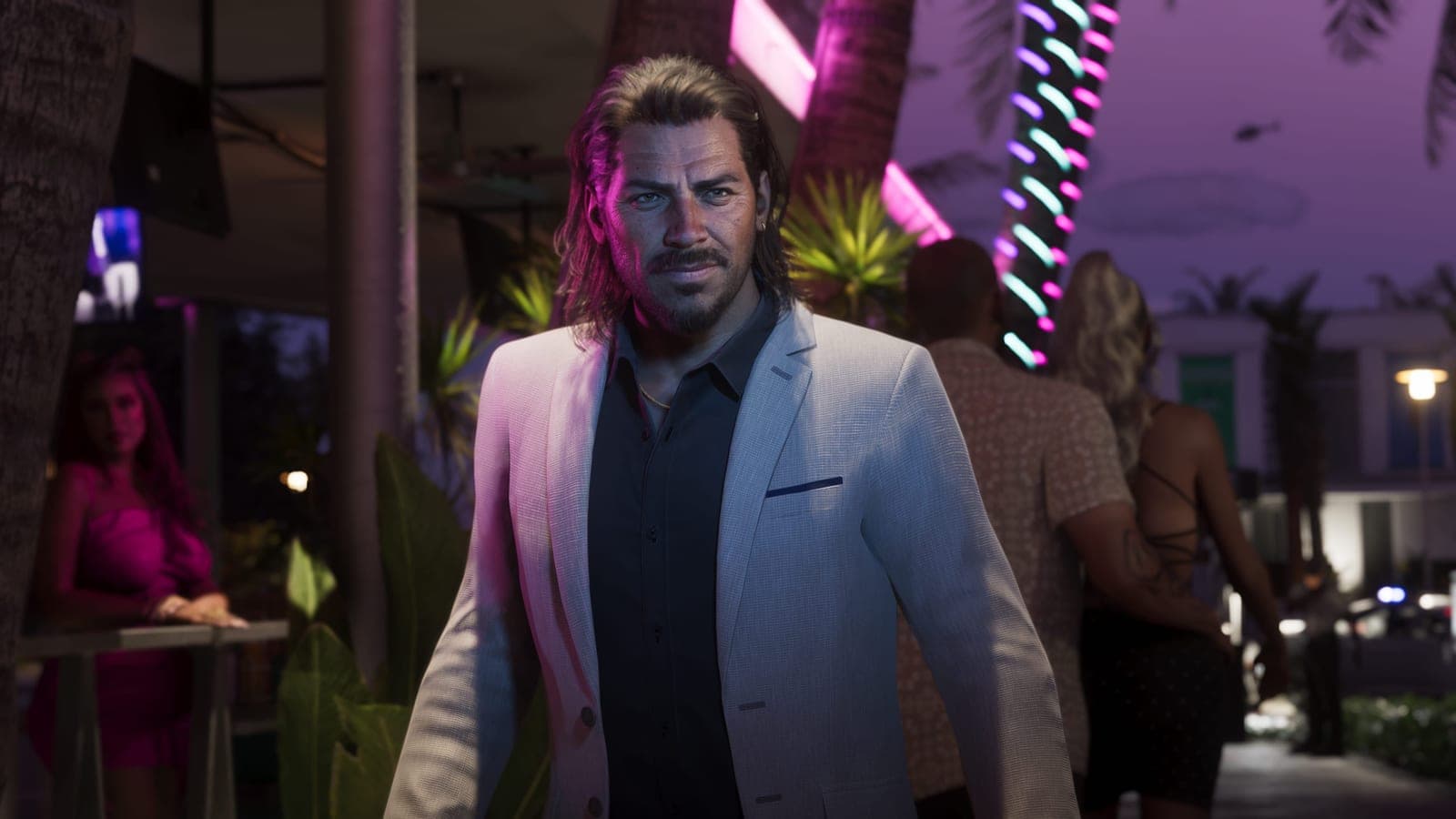
On the evening of 20 October 2026 the first Grand Theft Auto VI television commercial aired in the United States, during NBC's coverage of the NBA's opening night. It is not a new trailer. It is the launch trailer Rockstar published on 15 October, recut for broadcast: two shots gone, three shots held longer, and an end card that names one console instead of two.
The games press covered the cuts. That is the smallest thing in it. A television advert for an M-rated game is governed by a different rulebook than the game, and the edit is what that rulebook looks like in practice — which makes it predictable rather than newsworthy. The part worth keeping is the buy itself, because five months ago Take-Two's chief executive said the company would not be doing much of it.
What is established, and what is not
| Status | |
|---|---|
| A GTA 6 TV spot aired 20 October 2026 on NBC, during the NBA's opening-night broadcast | Reported concordantly |
| It uses footage from the 15 October launch trailer, recut | Reported concordantly |
| The Jason and Lucia shower kiss is absent | Reported concordantly |
| The brief shot of Lucia's ankle monitor is absent | Reported concordantly |
| Three existing shots run longer than in the online cut | Reported concordantly |
| The spot ends on a PlayStation logo, with no Xbox logo | Reported concordantly |
| Any Rockstar statement about any of it | None |
| The spot's runtime | Reports disagree — 30, 60 and 90 seconds all claimed |
| Whether a longer broadcast version keeps the shower material | Reports disagree |
| That the missing Xbox logo means anything about the Xbox version | Not established |
What the edit did
Two things come out. The kiss that follows the first shower shot is gone — by most accounts the shower shot itself survives, and only the kiss is cut — and so is the brief look at Lucia's ankle monitor.
Three things are held longer to fill the gap: Raul Bautista dancing, Lucia jumping onto an aircraft's landing gear, and Jason knocking Lucia towards the floor.
That is the whole of it. No shot in the broadcast version is footage the online trailer did not already contain, which matters because a run of headlines has described the advert as sneaking in unseen footage. What is unseen is a handful of extra frames at the head and tail of shots that were already public — the same material, given more room. A longer cut of a shot is not a new shot, and nothing in the spot shows a location, a character or a mechanic that 15 October did not.
Both removed shots are Lucia's. The lengthened dance shot is Raul Bautista's. None of this is a character revision; it is an editor fitting ninety seconds of trailer into a broadcast slot.
The cuts are the least surprising thing in the advert
Coverage has framed the edit as squeamishness. It is better understood as compliance, and the distinction is worth making because it is the difference between a decision and a rule.
The ESRB does not only rate games. It operates advertising principles, enforced through its Advertising Review Council, which require marketing to reflect the product's content and rating accurately and bar publishers from placing advertising for Mature-rated titles before audiences the rating does not suit. The assessment is made against the likely reaction of the general public rather than of the people who will buy the game. A prime-time national sports broadcast is about as general as an American audience gets.
The game's own label already names the material at issue. When the finished ESRB rating was published on 1 October, the descriptors included sex scenes, and PEGI's description was blunter still. A descriptor that justifies a 17+ label on the box is precisely the content that does not go into a commercial break, and the two facts are consistent rather than contradictory. Every board's published rating describes the game, not the advertising.
One caveat on this, because it is the sort of number that gets repeated: older accounts of the ESRB's advertising code cite a fixed audience threshold for television — a maximum share of under-17 viewers. We could not confirm any such figure in the ESRB's current published principles, so it is not stated here as a rule in force. The principle that Mature advertising must not be targeted at audiences the rating does not suit is published. A specific percentage is not.
What nobody has said is who made the cut, or why. Rockstar has not commented. Whether the broadcast version reflects an ESRB review, NBC's own standards, or Rockstar's judgement about a sports audience is unreported, and the three are not the same thing.
The missing Xbox logo, and how far the inference actually carries
The spot closes on a PlayStation logo alone. Grand Theft Auto VI ships on Xbox Series X|S on the same day, at the same price, with the same content, and the absence has been read online as evidence of a PlayStation marketing deal.
The inference is not baseless, but it is doing more work than its evidence supports. What exists on the record is this: Take-Two's chief executive, Strauss Zelnick, has been reported — by Bloomberg — as saying that the game's console-first release window was not related to the company's marketing arrangement with PlayStation. That answer implies an arrangement exists. Neither Sony nor Rockstar has announced one, no terms have been published, and the reporting that does exist describes promotion rather than exclusivity.
So the honest statement is narrow. A single-console end card on a co-marketed television spot is ordinary, and it establishes nothing about the Xbox version of the game. It is not evidence of a delay, a cut-down release or a change of platform. Readers who want a case where a platform claim about this game was reported and then publicly contradicted have the cloud-streaming episode for comparison; this is not that, because here nobody has claimed anything at all.
The part that is actually new
In May, ahead of Take-Two's investor call, Zelnick described the campaign to GamesIndustry.biz in terms that were widely quoted: "13 years ago we were still buying network television. We won't be buying a lot of network television." He promised instead "a very significant broad-based marketing campaign that reflects where audiences and attention is today" — read at the time, correctly, as streaming, creators and social platforms rather than broadcast.
Five months later the first advert for the game ran on NBC, in the NBA's opening-night window, which is among the most expensive inventory on American television.
Resist the obvious conclusion. "Not a lot" is not "none", and one spot is not a reversal. Zelnick did not promise to avoid television; he promised not to repeat 2013's weighting of it. A single national buy at the top of a launch run is compatible with every word of that. The write-ups treating this as a U-turn are reading a quantitative statement as an absolute one.
What the buy does tell you is the shape of the campaign's expensive end. Rockstar has been spending visibly and physically for weeks — the arena sign and the beach deal in Miami are matters of public record, with a county invoice attached — and television is the component that was supposed to be de-emphasised. It is now running, three and a half weeks before the 19 November release. Whether it stays a single flight or becomes a sustained buy is the thing to watch, and it is unknowable until it either repeats or does not.
What is not confirmed
- The spot's runtime. Accounts give 30, 60 and 90 seconds, and more than one version appears to be circulating.
- Which version retains which material. At least one account describes a longer cut that keeps the shower shots; others describe the longer cut as the one that drops them. This is unresolved and is not resolved here.
- Who required the cuts. No statement from Rockstar, the ESRB or NBC.
- Any current ESRB numerical audience threshold for television advertising. The principles are published; a percentage is not.
- The existence, terms or value of a PlayStation marketing agreement. Implied by Zelnick's reported answer to a different question; never announced by either company.
- That the end card implies anything about the Xbox release. It does not, and the Xbox Series X|S version remains a same-day release.
- Whether further television advertising is planned, in this window or any other.
- Any new footage. There is none in the spot. Every frame comes from the 15 October trailer.
The thing worth holding on to
A recut trailer is a marketing artefact, and reading shot lengths for meaning is the kind of exercise that produces confident nonsense. Two shots left a television advert because television adverts do not carry that material; that is the end of that story.
The buy is the fact. Take-Two said it would not lean on network television and has now bought the most visible slot on it, which does not contradict what it said but does tell you how the last month before release is being funded. Five weeks out, the campaign's reach matters more than its content — and for the first time, that reach includes people who were not looking for it.
Sourcing note: rockstargames.com, gamespot.com, kotaku.com, pcgamer.com and eurogamer.net all fail to resolve from this writer's network, so neither the advert nor any write-up of it was viewed first-hand and nothing here was taken directly from Rockstar. The broadcast date, the network and programme, the recut status, the two removed shots, the three lengthened shots and the PlayStation-only end card are carried as GameSpot and Kotaku reported them on or about 21 October, concordantly. The shot-by-shot comparison those reports draw on originates with RockstarINTEL, a fan outlet that is not among this site's sources, which is why the shot list is given at the level the reputable write-ups carry it and the runtime disagreement is left open. Zelnick's television remarks are quoted as GamesIndustry.biz published them in May and as several outlets reproduced them concordantly; the Bloomberg-reported remark about the PlayStation arrangement is likewise secondhand here. The ESRB advertising principles are described from the board's own published material.
Read next
Justice have described the GTA 6 score for the first time — and Rockstar still has not
Gaspard Augé and Xavier de Rosnay talked to BBC Radio 1 about scoring Grand Theft Auto VI: a futuristic sound rather than an eighties pastiche, a guitar part that is a synth, and the hype watched from the outside. What the first account from the people who wrote the music actually establishes, and what is still Rockstar's to explain.
GTA 6 has 6.45 million pre-orders — except nobody at Rockstar counted them
The pre-order figure running everywhere this week comes from Sensor Tower, a third-party analytics firm, not from Rockstar or Take-Two. The arithmetic holds together better than most circulating numbers. What it measures, what it leaves out, and why the company that knows the real total has refused to publish it.
Rockstar's most senior witness: what Jennifer Kolbe told the union tribunal on 16 October
The last sitting day before the Glasgow tribunal breaks until November produced evidence from the most senior Rockstar figure to appear in the case. She denied that Sam Houser screams at staff, said the company is not anti-union, and called it absolutely untrue that she had known about the union Discord for years. The games press did not cover any of it.